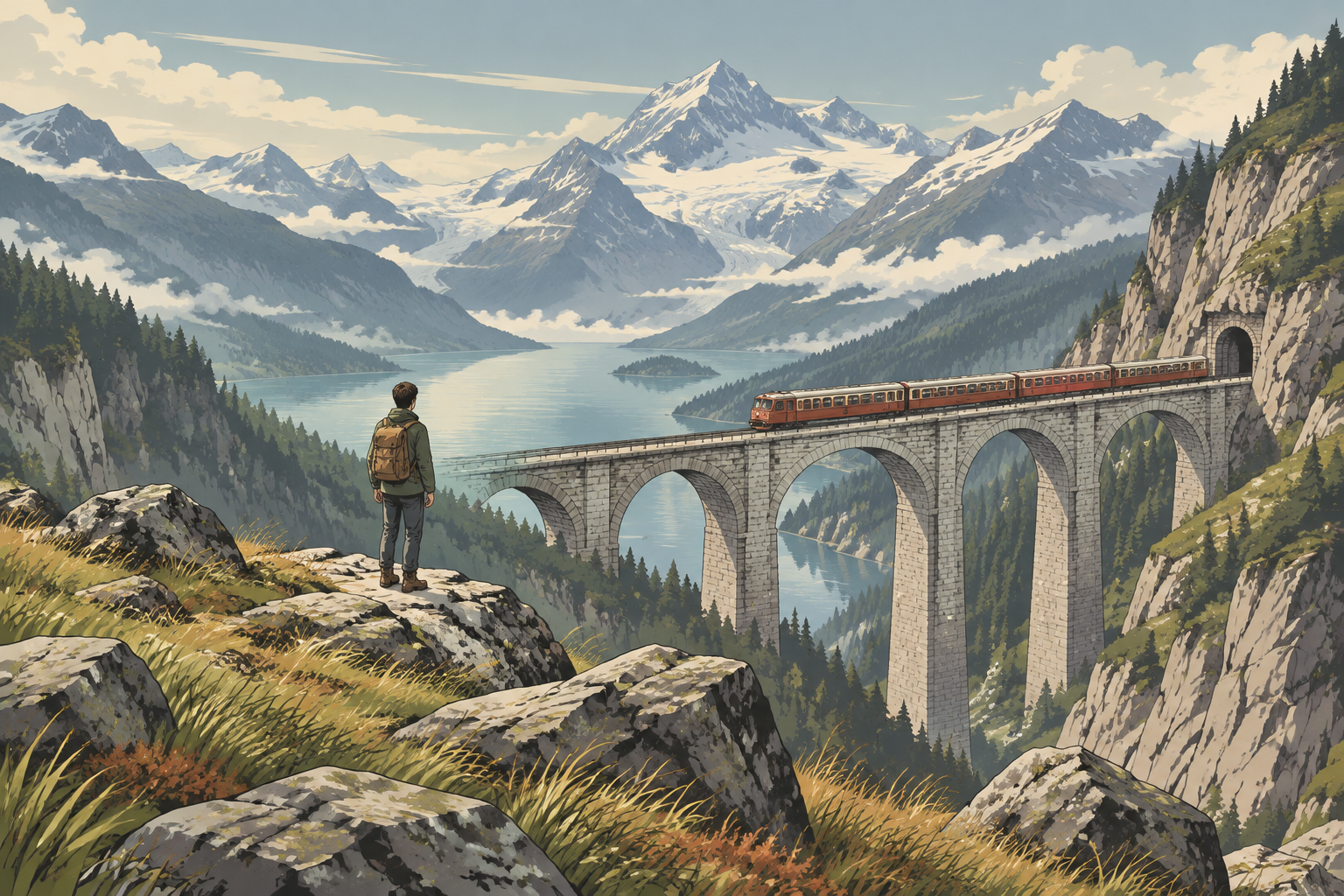
A plane moves you. A train takes you there. That is the whole difference. The landscape unrolls outside the window, there is no three-hour airport ritual, and nobody weighs your backpack.
The catch is that "Europe's most scenic trains" have turned into a tourist product. Panoramic expresses with glass roofs cost several times more than the ordinary service running on exactly the same rails, past exactly the same view. This guide is about riding Europe's five best railway lines the smart way: which route, which seat, and where the money actually goes.
TL;DR - five lines, one trick each
| Line | Where | Duration | Key trick |
|---|---|---|---|
| Bernina & Albula Line | Switzerland - Italy | 4 h | Take the regional RhB train, not the Bernina Express |
| Bergensbanen & Flåmsbana | Norway | 7 h + 1 h | Book Lowfare 90 days ahead, ride Flåm at dawn |
| West Highland Line | Scotland | 5.5 h | Ordinary ScotRail instead of the steam Jacobite |
| Semmeringbahn | Austria | 1 h | Direct Railjet, perfect as a weekend trip |
| Belgrade - Bar | Serbia - Montenegro | 11 h | Daytime service only, or you miss the canyons |
1. Bernina & Albula Line: glaciers without a summit tunnel
Chur - St. Moritz - Tirano, Switzerland and Italy
Europe's most famous mountain railway and a UNESCO World Heritage site. The train climbs out of the Rhine valley, threads the Albula valley across the Landwasser Viaduct (the one that disappears straight into a cliff face), crosses the Bernina Pass at 2,253 m without a single summit tunnel, and spirals down to Italian Tirano on the open circular viaduct at Brusio. On the way you pass the Morteratsch glacier and Lago Bianco.
Smart tip: skip the Bernina Express. An ordinary red Rhaetian Railway regional train runs the identical route roughly every hour. The difference: the panoramic express charges a compulsory seat reservation on top of the fare (around CHF 26 in summer) and its sealed glass windows mean every photo has a reflection. Regional windows open, no reservation is needed, and you can hop off and catch the next train whenever you like.
Where to sit: left-hand side from Chur to Tirano (Landwasser, Lago Bianco), right-hand side coming back.
When to go: June to October for the pass. The line runs in winter too, but you trade lakes for a white plain.
Switzerland is outside EU roaming, so sort out data separately or one map lookup will cost you more than lunch.
2. Bergensbanen & Flåmsbana: from the high plateau into a fjord
Oslo - Myrdal - Flåm - Bergen, Norway
Seven hours across Norway, of which ninety minutes cross the Hardangervidda plateau: bare tundra above the treeline, frozen lakes, and snow fences still standing in June. At Myrdal you change to the Flåm Railway, one of the steepest adhesion railways in the world, dropping 866 m over 20 km to the shore of the Aurlandsfjord.
Smart tip: book early. Norwegian railways release tickets 90 days in advance and the Lowfare tariff can be 60 % below the walk-up price. Flåmsbana has a fixed fare, but timing is free: stay in Myrdal or Flåm and ride the first morning service before the coaches and cruise passengers arrive. The difference is an empty carriage versus a queue for the Kjosfossen waterfall photo stop.
Where to sit: left-hand side from Oslo to Bergen. On the Flåm line everyone migrates between windows anyway.
Paying in Norwegian kroner is a classic fee trap. A card with a fair exchange rate pays for itself on day one.
3. West Highland Line: moorland, a viaduct and the Atlantic
Glasgow - Fort William - Mallaig, Scotland
Regularly voted the most scenic rail journey in Britain. First Loch Lomond, then Rannoch Moor, where the track floats on a bed of brushwood and ash and no road comes anywhere near. The finale is the Glenfinnan Viaduct and a run along the coast facing the islands of Eigg and Rùm.
Smart tip: skip the steam Jacobite. Ordinary ScotRail services cross Glenfinnan too, several times a day, for a fraction of the price and without booking months ahead. If you want a photo of the steam locomotive, get off at Glenfinnan and walk up to the viewpoint.
Where to sit: left-hand side from Fort William to Mallaig for the curve of the viaduct. On Rannoch Moor it makes no difference; it is empty both ways.
British fares often drop sharply when a journey is split into segments. Doing that by hand is tedious; an app works it out for you.
4. Semmeringbahn: the easiest UNESCO railway to reach
Gloggnitz - Semmering - Mürzzuschlag, Austria
The world's first mountain railway, built between 1848 and 1854, and the first railway ever inscribed by UNESCO. Forty-one kilometres, sixteen viaducts and fifteen tunnels cut into limestone in an era of pickaxes. The two-tier Kalte Rinne viaduct is still a masterclass in making infrastructure fit a landscape.
Smart tip: treat it as a weekend, not an expedition. Direct Railjet services from Prague and Brno towards Graz run straight over the Semmering. Get off at Semmering station and walk part of the Bahnwanderweg, the marked trail along the line that looks down on trains crossing the viaducts. Rejoin the railway a station further on.
Where to sit: right-hand side climbing from Gloggnitz.
Advance international fares differ by day and direction between operators, so compare them in one place.
5. Belgrade - Bar: Europe's cheapest adventure
Belgrade, Serbia - Bar, Montenegro
For anyone who finds Switzerland a little too tidy. Eleven hours, 254 tunnels and 435 bridges. The highlight is the Mala Rijeka viaduct, 200 m above the canyon floor and for decades the highest railway bridge in Europe. Then the descent past Lake Skadar to the Adriatic. The ticket costs around twenty euros, which for this ride borders on absurd.
Smart tip: daytime train only. The overnight service saves you a hotel but hides everything worth seeing. The daytime train leaves Belgrade in the morning and puts the Morača canyon and Mala Rijeka in daylight. Expect delays, expect the air conditioning to be optional, and bring your own water and food.
Where to sit: right-hand side from Belgrade to Bar.
What to bring on board
Long rail journeys forgive more than flights, but a few things decide the day:
- Power bank. Sockets in older carriages are often dead or fitted to only some seats. Navigation and photos drain a phone fast.
- Insulated mug. Coffee on Swiss and Norwegian trains is expensive; in the Balkans it may not exist at all.
- Layers. Ten degrees between valley and pass is normal, and the Bernina stops are windy.
- Offline maps. There is no signal in tunnels or on the Hardangervidda, which is exactly where you want to know what you are looking at.
- A small day bag. Keep water, camera and a sweater within reach and put the rest on the rack.
How to put a trip together
The sensible move is not to chain all five into one journey. Semmering is a weekend from Central Europe. Bernina slots into a week in Switzerland or Italian Valtellina. Bergensbanen is the backbone of an Oslo - Flåm - Bergen loop. Belgrade - Bar is its own Balkan trip and does not belong anywhere else.
Only if you plan three or more of these lines in a single month does an Interrail pass start to pay off. For one or two routes, advance point-to-point tickets are cheaper.