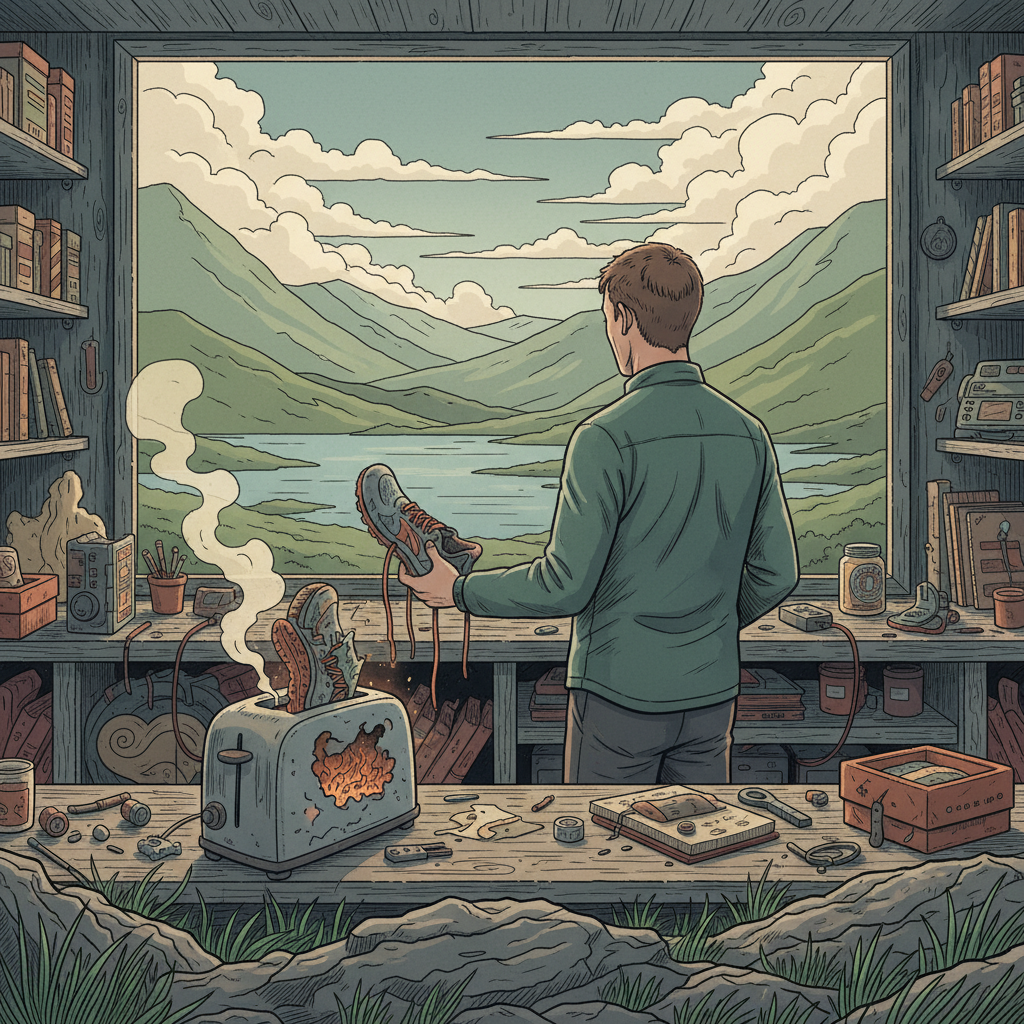
A high-school kid modifying shoes in a toaster oven
In the late 1990s, in Orem, Utah, sits a little running store called Runner''s Corner. It''s owned by Golden Harper''s family, and young Golden grows up literally between shoeboxes. He sees who buys what, who comes back with blisters, whose Achilles hurts, whose big toe is bending sideways.
And he notices one thing repeating: most running shoes have an elevated heel and a tapered toe box. The human foot, though, has a different shape - a wide forefoot the toes need to push off, and an arch that works best on a level platform.
As a fifteen-year-old, Harper asks a simple question: What if the heel and forefoot were at the same height, and what if the big toe finally had room to point straight?
He starts looking for the answer at home. In his parents'' toaster oven.
A toaster oven as the first R&D lab
The principle is primitive and unexpectedly effective. Harper puts a regular running shoe into the toaster oven at around 135 °C. He waits until the glue starts to bubble - then takes off the sole, grinds the elevated heel down, levels the midsole, and reglues the shoe. Then he stretches the toe box wider.
The first prototypes are ugly. But they work. In school he sits next to Brian Beckstead, also a passionate runner - and the two realize this isn''t just a hobby, there''s a business in it.
Except they don''t have money.
"I remember asking my dad what to set the toaster oven to. He said about 135 degrees, and to wait until the glue started bubbling."
- Golden Harper
2009: Altra is founded, a house gets mortgaged
Harper and Beckstead first try to pitch their concept to established manufacturers. No one is interested - a shoe that looks wider and less athletic than the competition is, in the eyes of marketing managers, commercial suicide.
So they decide to build the brand themselves. Beckstead''s father helps with the starting capital - by mortgaging his house. Altra is founded in 2009. The first commercial models hit shelves in 2011 - the road Instinct and the trail Lone Peak, which becomes the brand''s flagship.
Three rules that don''t change
Every Altra model from the start stands on three principles:
- FootShape™ toe box - anatomically shaped, wide front that respects the actual shape of the foot. Toes don''t crowd, the big toe points straight.
- Balanced Cushioning™ (Zero Drop) - heel and forefoot at the same height. No tilt forward, unlike conventional trainers (typically 8-12 mm).
- Cushioning to match purpose - from minimalist models to maximalist trail "armchairs". Zero drop doesn''t mean little foam underfoot.
In an industry that spent twenty years selling technology in the heel, this is the opposite approach: the shoe should adapt to the foot, not the other way around.
Milestones that changed the rules
| Year | What happened |
|---|---|
| 1996-2008 | Golden Harper modifies regular shoes in a toaster oven, gradually formulating the FootShape and Zero Drop principles. |
| 2009 | Altra is founded. Starting capital partly from Beckstead''s father mortgaging his house. |
| 2011 | First commercial models - road Instinct and trail Lone Peak. |
| 2018 | VF Corporation (The North Face, Vans, Timberland) acquires Altra. Revenue around USD 50 million, sold in 50+ countries. |
| 2020 | Lone Peak becomes the default shoe on PCT, AT and CDT - a symbol of long-distance hiking. |
| 2023 | Altra drops the zero-drop dogma: alongside 0 mm models come 4 mm versions. The toe box stays. |
| 2025 | Annual revenue around USD 200 million, ~25 % year-over-year growth. The fastest-growing brand in VF''s outdoor portfolio. |
Lone Peak: how a single trail shoe redefined long trails
If Altra has one model that defines it, it''s the Lone Peak. A light trail shoe whose combination of FootShape toe box, level platform and flexible outsole gave thru-hikers something they didn''t have before: a shoe you can walk two thousand miles in with minimal injury.
On the Pacific Crest Trail (4,270 km), the Appalachian Trail (3,540 km) and the Continental Divide Trail (5,000 km), Altra Lone Peak is today the most visible shoe on hikers'' feet. The community has its own ritual: at the end of the PCT, hikers pose with their shredded Lone Peaks on a wall - sometimes the fifth or sixth pair of one season.
The result: Altra became the standard of long-distance hiking without ever officially aiming there.
2018: VF Corporation and the major league
In 2018, VF Corporation notices Altra - the global group behind The North Face, Vans, Timberland and Smartwool. The acquisition is small for VF, but strategic: running and outdoor are growing, trail is going mainstream, and Altra has something on the shelf that''s hard to confuse with the competition.
Under the new owner, the brand steps out of the niche shadow into a wider outdoor business. While in the year of the acquisition revenue was around USD 50 million, today - according to VF leadership - it''s pushing USD 200 million annually, growing ~25 % year-over-year. That still doesn''t make it Hoka or Nike. But it makes it one of VF''s fastest-growing brands overall.
2023: end of the zero-drop dogma (and why it makes sense)
In September 2023, the brand announces something that mildly shocks its fans: not all models will be zero drop anymore. Alongside the classic zero, they''ll offer 4 mm drop. The logic is both commercial and human - not every runner can switch from 10 mm drop straight to zero, and a zero-drop shoe takes months of calf and Achilles adaptation.
For those who fell in love with Altra for the level platform, it''s a step back. For the brand, it''s a gateway to the mass market. The foot shape and wide toe box philosophy stays - and in practice, that''s the part that decides whether a shoe starts pinching after a few hours or not.
My personal take
Altra shoes are the most "travel-friendly" trainers we''ve tried. And it''s not comfort in a soft-pillow sense - it''s room. The wide toe box is the difference between a red toe after twelve hours of walking and a toe shredded by the seam.
For long days in terrain - from trekking through desert dust to humid jungles - Lone Peak has been a long-term staple in our kit. It''s not for everyone (if you''ve been in 10 mm drop your whole life, give it weeks of adaptation and start with short runs). But once you give it time, it pays back in healthier feet, fewer blisters and - surprisingly - shorter recovery between stages.
Recommended model for travelers
If you want one Altra that handles a long trek, urban transit and light terrain:
A classic trail shoe with FootShape toe box, MaxTrac outsole and weight under 300 g. Dries overnight, folds into a backpack, lasts hundreds of kilometers.
Keep reading
Altra is just one piece of the smart-travel puzzle. If you''re curious how to pack lighter, choose more durable gear and walk longer without blisters, dive in:
- 👟 Travel Gear - reviews of shoes, packs and everything I actually carry.
- 🥾 Shoes Category - barefoot and trail models I''ve broken in for real.
- 💡 Practical Tips and Guides - how to save on roaming and pack into carry-on.
- 🌍 Brand Stories - why traveling with the right companies matters.
- 🧮 Travel Calculators - backpack weight, daily budget, water consumption.
Closing
Altra isn''t a fashion revolution; it''s a return to basics. A high-schooler with a toaster oven who noticed that a shoe should adapt to the foot - not the other way around.
It''s not about the brand. It''s about whether we can get used to the idea that the foot isn''t a problem to be solved by an elevated heel. That all it needs is room, a level platform and enough time to learn how to work again.
And that may be the best service a shoe can give a traveler - letting them go further than they thought.